If you’ve ever been told “just wear a mask,” here’s why that advice often doesn’t work for people with Multiple Chemical Sensitivity (MCS), with science-backed context.
“Can’t You Just Wear a Mask?”
If you live with Multiple Chemical Sensitivity (MCS), you’ve probably heard this:
“Why don’t you just wear a mask?”
It sounds simple. Masks are widely used to block harmful exposures.
But when it comes to chemical sensitivity, that advice often doesn’t match how exposure actually works.
For many people with MCS, masks don’t solve the problem—and sometimes, they can make symptoms worse.
The Key Issue: Chemicals Are Not Particles
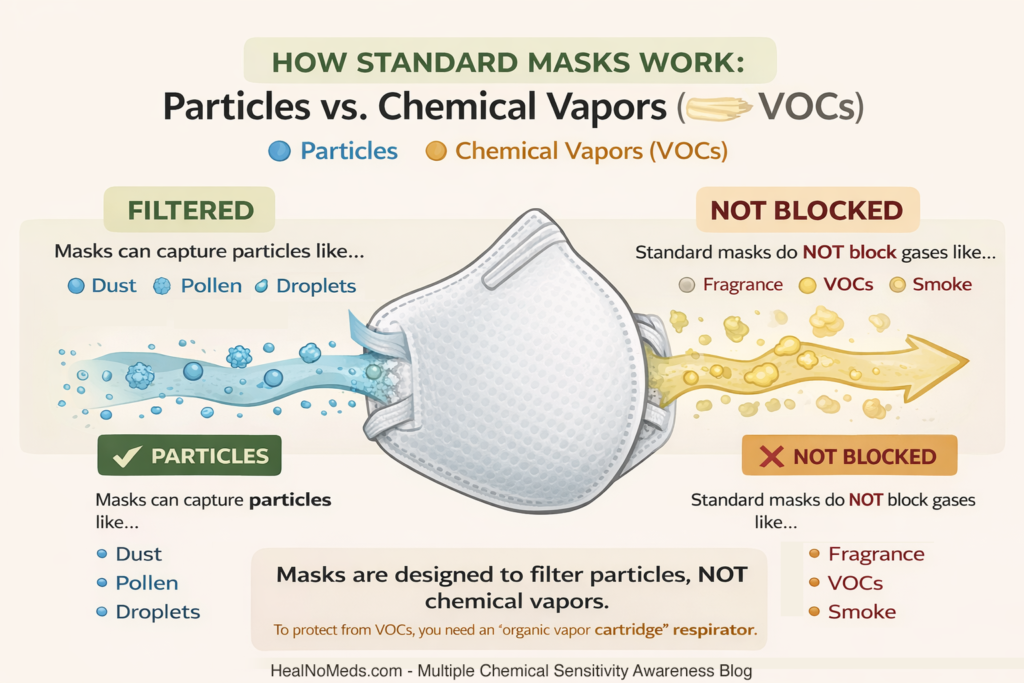
Most common masks (including N95, KN95, and surgical masks) are designed to filter:
- Dust
- Droplets
- Airborne particles
They are not designed to block gases or chemical vapors.
Fragrances and cleaning products release volatile organic compounds (VOCs), and many people don’t realize how toxic fragrance exposure can actually be.
These behave differently:
- They exist as gases, not particles
- They can pass through standard mask materials
According to the Centers for Disease Control and Prevention and National Institute for Occupational Safety and Health:
- N95 respirators filter particulates, not gases or vapors
- Protection from gases requires specialized cartridges designed for organic vapors
👉 Source: https://www.cdc.gov/niosh/npptl/topics/respirators/disp_part/default.html
The Environmental Protection Agency explains that VOCs are common indoor air pollutants released from everyday products.
👉 Source: https://www.epa.gov/indoor-air-quality-iaq/what-are-volatile-organic-compounds
Why Masks Don’t Help with MCS (and Can Make Symptoms Worse)
1. Trapping and concentrating exposure
Masks create a small enclosed space around your nose and mouth.
If chemicals are present in the environment:
- They can become trapped and concentrated
- You may end up re-breathing the same air repeatedly
For someone with MCS, this can intensify:
- Headaches or migraines
- Nausea
- Brain fog
2. Mask materials can trigger reactions
Most masks are made from synthetic materials such as:
- Polypropylene (plastic fibers)
- Adhesives
- Elastic components
Some people notice:
- A smell when opening a new mask
- Stronger reactions with certain brands
Even low-level chemical exposure—especially close to the face—can be enough to trigger symptoms in sensitive individuals.
3. Heat, humidity, and airflow changes
Wearing a mask:
- Increases humidity near the face
- Alters airflow
- Reduces fresh air exchange
For some people, this can contribute to:
- Head pressure
- Lightheadedness
- A general “off” feeling
4. Physical pressure and skin irritation
Masks apply pressure to:
- Nose bridge
- Cheeks
- Ears
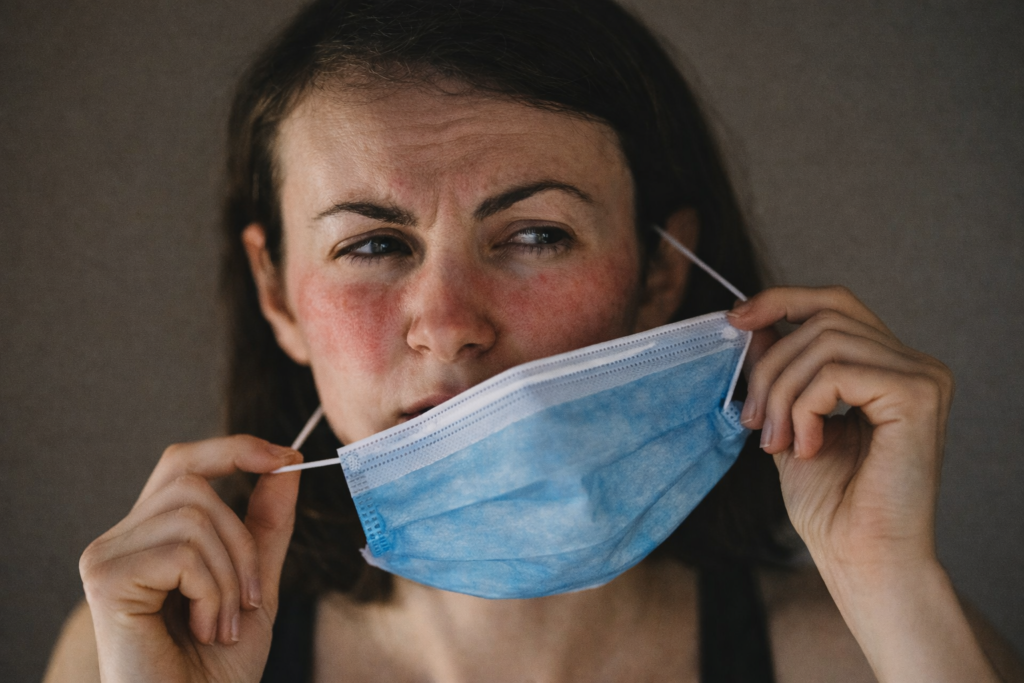
They can also cause:
- Itching
- Burning
- Redness
For people with overlapping sensitivities (MCS, fibromyalgia, skin sensitivity), this can quickly become uncomfortable or even painful.
What Does Filter Chemical Exposure?
There are masks that can help with chemical exposure—but they are different from standard masks.
Respirators with:
- Activated carbon
- Organic vapor cartridges
…are designed to filter certain gases and vapors.
However:
- They are not 100% effective
- They must fit properly
- They can still be difficult to tolerate for some people
What the Research and Guidelines Suggest
Standard masks:
- Work well for particles
- Do not reliably block VOCs or gases
The Environmental Protection Agency emphasizes that reducing exposure to indoor pollutants is most effective when:
- The source is removed or reduced
- Air is ventilated or filtered
👉 Source: https://www.epa.gov/indoor-air-quality-iaq/improving-indoor-air-quality
Why “Just Wear a Mask” Misses the Point
For people with MCS:
- The issue is not just inhaling particles
- It’s reacting to airborne chemicals at very low levels
And those chemicals:
- Often pass through standard masks
- May become more concentrated near the face
- Can still trigger symptoms even with partial filtration
So while masks may help in some situations, they are not a reliable solution for chemical sensitivity.
A More Realistic Approach
From both lived experience and current understanding:
- Avoiding triggers is often the most effective strategy
- Fragrance-free environments make a significant difference
- Ventilation and clean air matter more than masks alone
- Masks may be used as a limited, situational tool—not a full solution
If You’re Trying to Support Someone with MCS
Instead of suggesting a mask, what helps more:
- Avoid wearing fragrance
- Use unscented products
- Meet in well-ventilated spaces
- Be open to adjusting environments
These changes often make a far bigger difference than a mask.
Important Note
This article combines lived experience with publicly available safety guidance.
It is not medical advice. If you experience severe symptoms (such as trouble breathing, chest pain, or fainting), seek medical care.
FAQ
Do masks ever help with MCS?
Sometimes—but typically only specialized respirators designed for chemical filtration, and even those are not perfect.
Why do some people tolerate masks without issues?
Sensitivity levels vary widely. What affects one person may not affect another.
Is this psychological?
Chemical sensitivity reactions are physical responses to environmental exposures. The experience is real, even if not fully understood.